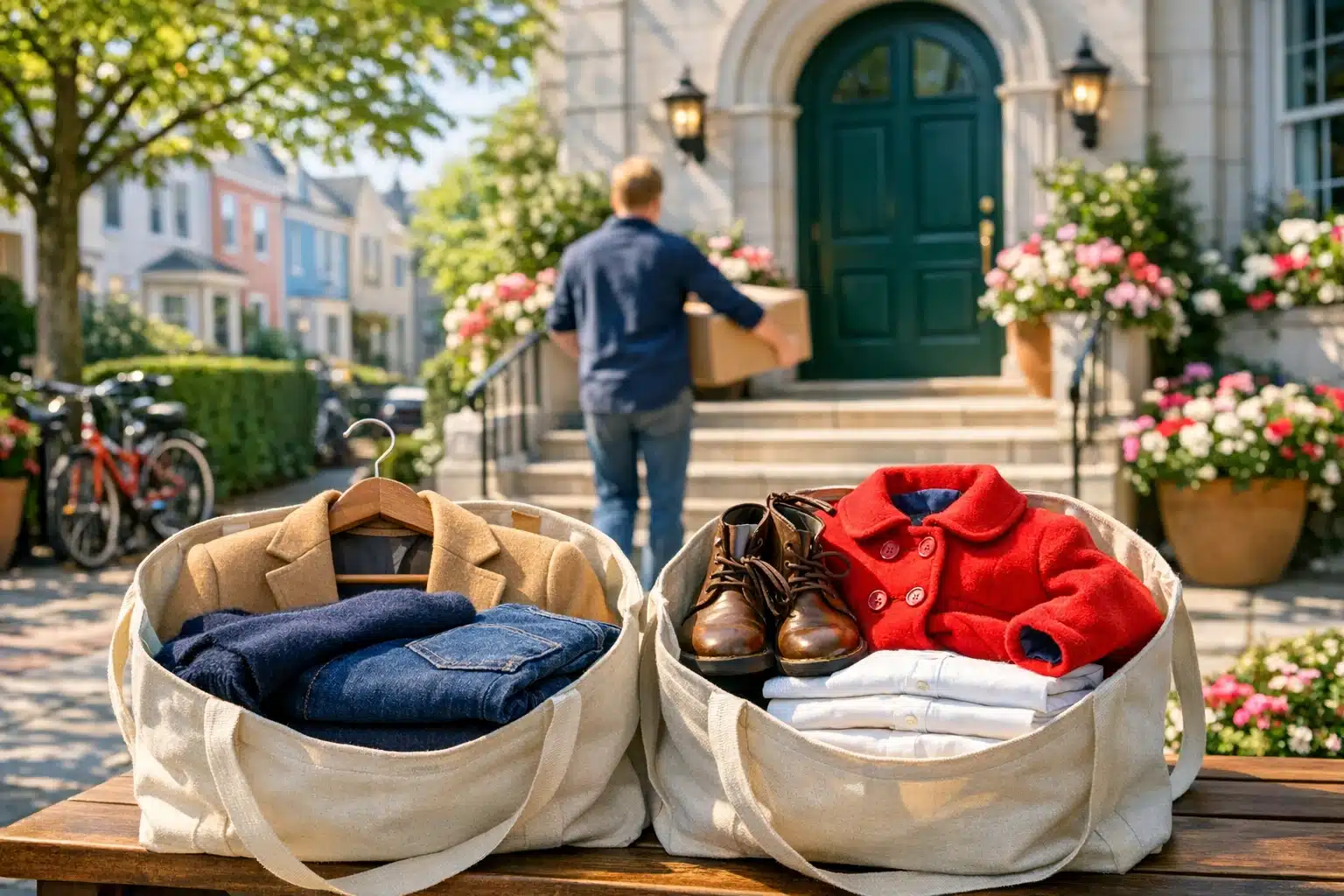
Where to donate the clothes
A closet full of unworn shirts, jeans, and jackets is more than a storage problem; it is a quiet chance to help someone else. When you donate thoughtfully, your clothes can support families, shelters, job seekers, and local reuse programs instead of drifting into landfill. The tricky part is knowing which organization, drop-off point, or community network fits the condition and purpose of what you are giving away. This guide walks through the main options, what each one does well, and how to make sure your donation is genuinely useful.
Outline
- How to decide where each item should go based on condition, usefulness, and urgency.
- The role of charities, thrift stores, and nonprofit donation centers, including how they differ.
- Local and direct-giving options such as mutual aid groups, schools, shelters, and neighborhood networks.
- Specialized places for workwear, winter clothing, kids’ items, formalwear, and worn-out textiles.
- How to prepare, pack, label, and deliver donations so they are easy to accept and more likely to help.
Start by matching the clothing to the right destination
The best place to donate clothes is not always the nearest bin in a parking lot. A smarter starting point is to look at what you have and ask a simple question: who can use this, in this exact condition, right now? That one habit can completely change the impact of your donation. A nearly new blazer might help someone preparing for a job interview. A bag of children’s winter coats may be perfect for a school, foster care organization, or refugee support group. A stretched-out T-shirt with stains, on the other hand, may not belong in a charity donation stream at all and could be better handled through textile recycling if that service exists locally.
Clothing donation works best when the item matches the needs of the organization. Many charities are grateful for usable clothing, but they still need time, labor, and storage space to sort it. If donors send torn, dirty, moldy, or unusable pieces, the receiving group may have to spend money disposing of them. In other words, giving carelessly can create work instead of reducing it. This is one reason some organizations are selective about what they accept, even when their mission sounds broad. A little sorting at home saves effort on the other end.
A practical way to sort your clothing is to create categories before you leave the house:
- Excellent condition: clean, modern, wearable, and ready to use immediately.
- Good everyday condition: gently worn basics for thrift stores, shelters, or community groups.
- Special-purpose items: business clothing, uniforms, coats, baby clothes, formalwear, or shoes.
- Damaged but recyclable: textiles too worn for reuse but suitable for fiber recycling if available.
Think about timing as well. Donations are often most useful when they meet a seasonal or urgent need. Warm coats are not just “nice to have” in winter; in many places they are essential. Back-to-school periods create demand for children’s clothes and shoes. Prom season often sparks dress drives. During disasters, local relief groups may request specific items rather than general drop-offs. If you pay attention to timing, your donation becomes more precise and more helpful.
There is also a difference between donating for resale and donating for direct use. Resale-based nonprofits often turn clothing into funding for broader programs such as job training, community services, or rehabilitation support. Direct-use programs place clothing into the hands of people who need it quickly, often at no cost. Neither model is automatically better. The right choice depends on what you want your donation to do. A clear-out bag can feel like a single action, but it really contains many possibilities. Once you start matching item to purpose, your closet becomes less of a dumping ground and more of a distribution center with a conscience.
Charities, thrift stores, and nonprofit donation centers
For many people, the most familiar answer to the question of where to donate clothes is a charity shop or nonprofit thrift store. These organizations are widely available, easy to use, and often designed to process large volumes of household donations. In practical terms, they are a strong option for everyday clothing in good condition: jeans, sweaters, jackets, children’s basics, shoes, and accessories that still have plenty of life left. Their advantage is convenience. Many have drive-through drop-off points, donation trailers, or neighborhood collection sites, which makes it easier for donors to follow through instead of postponing the task for another month.
Still, not all donation centers work the same way. Some organizations sell donated items in retail stores and use the proceeds to fund social programs. Others combine resale with direct assistance. Some local shops are run by churches, hospitals, hospice groups, animal rescues, or community foundations. The difference matters because the same bag of clothes can lead to different outcomes depending on where it goes. One nonprofit may turn it into job training funds, another may provide vouchers to low-income families, and another may stock an emergency clothing closet.
Before donating, it helps to compare a few basics:
- What condition of clothing is accepted?
- Does the organization use items directly, resell them, or both?
- Are there limits on shoes, underwear, formalwear, or out-of-season clothing?
- Does the group provide a donation receipt if you want one for record-keeping?
- Is the drop-off site regularly maintained and clearly connected to a legitimate organization?
This last point is worth pausing on. Not every collection bin is equally transparent. Some are run by charities, but others are operated by for-profit textile collectors. That does not automatically make them bad, but donors should know where items are going. A well-labeled site should identify the operator and explain the purpose of the collection. If the bin is overflowing, poorly marked, or looks abandoned, choose another option. A bag left beside an overfilled container is more likely to be damaged by weather or discarded.
Traditional nonprofit donation centers are particularly useful when you have mixed clothing in solid condition and want a simple, efficient drop-off experience. They are less ideal when you have highly specialized items or when you want to ensure direct placement with a specific group. For example, a nonprofit thrift store may accept a business suit, but a workwear program may use it more effectively. Think of charity shops as broad, reliable channels rather than one-size-fits-all solutions. They do important work, but they are strongest when donors give them what they are built to handle: clean, wearable, everyday clothing that can be sorted, sold, or redistributed without extra rescue work.
Local groups and direct giving can make donations more personal
If you want your clothing to reach people quickly and locally, direct-giving options are often the most satisfying route. These include mutual aid networks, neighborhood groups, school resource centers, churches, refugee support organizations, domestic violence shelters, foster care nonprofits, and community closets. Unlike large donation systems, these groups often respond to very specific needs. One week they may request children’s sneakers in common sizes. Another week they may need men’s coats, school uniforms, maternity wear, or plus-size basics. That level of specificity can make your donation far more useful than dropping off a general bag and hoping for the best.
Direct giving also reduces the distance between the donor and the need. Many communities now use local online groups where residents post requests and offers. Buy Nothing groups, community Facebook pages, mutual aid chats, and neighborhood forums are common examples. When used respectfully, they allow you to say, “I have three winter sweaters and a pair of size eight boots,” and connect with someone who actually wants them. It is a simple idea, but it can feel refreshingly human. Instead of clothing disappearing into a system, you know it is heading to a person, a family, or a local project with a real and immediate purpose.
Some of the most practical places to ask about clothing needs include:
- Homeless shelters and transitional housing programs
- Domestic violence shelters that help people leave quickly with few belongings
- Schools with family resource centers or social workers
- Organizations supporting refugees, asylum seekers, or recent migrants
- Churches, mosques, temples, and community centers with clothing closets
- Foster care programs that often need children’s clothing on short notice
That said, local giving requires a little more communication. Many shelters cannot accept walk-in donations at all times because of storage limits, privacy concerns, or health rules. Some need only certain categories, and many prefer appointments. It is always better to call, email, or check an up-to-date page before arriving. Asking first shows respect and helps the organization avoid sorting through items it cannot use.
Direct donation works especially well for practical, ready-to-wear basics. It is less effective when you want a quick, anonymous drop-off with no extra steps. But if you have ever wanted your donation to feel less like disposal and more like neighborly transfer, this route is worth the extra effort. A folded stack of children’s shirts handed to a school resource room may not look dramatic, yet for a parent trying to stretch a week’s budget, it can remove one more pressure point. That is the quiet power of local giving: no spotlight, no fanfare, just clothing landing where it matters most.
Specialized donation programs and textile recycling options
Some clothes should bypass general donation centers entirely because they fit a more specialized need. This is where targeted programs shine. Business attire can go to employment-focused groups that support interviews and workplace readiness. Formal dresses and suits may be welcome in prom or graduation clothing drives. Baby clothes often make sense for family shelters, parenting support centers, or organizations helping new mothers. Winter gear can be directed to coat drives, homeless outreach groups, or school-based programs in colder regions. The more specific the item, the more likely it is that a specialized route will create a stronger outcome.
Workwear is a good example. A standard thrift store can certainly resell a blazer or button-down shirt, but a job-readiness program may turn that same item into confidence, practicality, and access. Someone preparing for interviews may need more than fabric; they may need clothing that signals readiness in a hiring process where appearance still carries weight. In the same way, sturdy shoes, plain slacks, scrubs, chef coats, or weatherproof outerwear can all have value beyond resale if they are directed to the right place.
Then there is the category many donors avoid thinking about: worn-out textiles. Not every garment is fit for another person, and pretending otherwise does not help. If clothes are ripped, badly stained, stretched beyond wear, or missing key parts, general donation may not be appropriate. That does not mean the only destination is the trash. Some municipalities, brands, retailers, and recycling services accept textiles for fiber recovery, industrial rags, insulation, or other secondary uses. Availability varies widely, so local research matters, but textile recycling is an important option for the last stage of a garment’s life.
Items that often benefit from specialized handling include:
- Interview clothing and office wear
- Prom dresses, suits, and occasion outfits
- Coats, gloves, scarves, and winter boots
- Baby clothes, maternity wear, and children’s uniforms
- Scrubs, trade clothing, and practical work gear
- Damaged textiles suitable only for recycling
There is one more useful distinction here: reuse versus recycling. Reuse keeps the garment intact and almost always preserves more of its value. Recycling is still worthwhile, but it generally comes later in the chain. If a coat can keep someone warm, that is better than reducing it to fiber. If a shirt can be reworn, that is usually better than shredding it. The goal is not to send everything into the same stream. It is to place each item on the highest useful rung available. That is how thoughtful donation becomes part of a more responsible clothing cycle, one that respects both people and materials instead of treating every old garment as the same kind of problem.
How to prepare your donation so it is accepted and appreciated
Where you donate matters, but how you donate matters almost as much. A well-prepared donation is easier to sort, easier to distribute, and more likely to be used. Start with the basics: wash what can be washed, pair shoes together, empty pockets, button shirts, zip jackets, and fold items neatly. If something smells strongly of smoke, mildew, perfume, or pet odor, clean it before donating if possible. These details sound small, but they affect whether an item can move directly into use or becomes another problem to manage.
Good preparation also means honesty. If you would not give a stained, torn, or dirty piece of clothing to a friend, it probably should not go into a standard donation bag. A common mistake is using donation as a guilt-free exit for items that are essentially waste. That impulse is understandable, especially during a big cleanout, but it shifts disposal costs to someone else. Donate what is wearable, recycle what is no longer wearable, and discard only what has truly reached the end of the line.
A useful checklist before drop-off looks like this:
- Confirm the organization’s current acceptance rules
- Sort by category if the group requests it
- Pack clothing in secure bags or boxes that can handle transport
- Label specialized items such as business wear or children’s clothing
- Do not leave donations outside after hours unless the organization says it is allowed
- Request a receipt only if you genuinely need one for your records
Timing can improve the experience too. Donating during posted intake hours reduces the chance that items will sit outdoors. Bringing seasonal clothing before demand peaks can help staff plan better. If you are donating in large volume, call ahead. A shelter may happily accept ten coats but have no room for twenty bags of mixed summer clothes. Communication prevents frustration on both sides.
Finally, try to treat donation as a habit rather than a one-time purge. A closet cleanout every year is helpful, but a slower cycle can be even smarter: when one item comes in, consider whether another can leave. Keep a small bag or box at home for wearable pieces you no longer use. This turns donation from a dramatic weekend event into an ordinary rhythm. And that may be the most sustainable approach of all. Clothes leave your home while they still have value, organizations receive items in better condition, and you avoid the familiar mountain of fabric that appears only when a drawer finally refuses to close.
Conclusion: donate with intention, not just convenience
If you are staring at a pile of clothes you no longer wear, the main takeaway is simple: the best donation choice depends on the item, its condition, and the kind of impact you want to make. Large nonprofit donation centers are useful for clean, everyday clothing and easy drop-offs. Local groups and shelters can place practical items directly into people’s lives. Specialized programs are often the best home for workwear, winter gear, children’s items, or formal clothing, while worn-out textiles may need a recycling route instead. For donors, the goal is not just to clear space fast. It is to send each piece where it can still do some good, with dignity for the receiver and with less waste for everyone else.